
STYLEMECHANICS
YOUR CART
Review it here or open the full cart before checkout.
Your cart is currently empty.
Continue ShoppingYou do not need to know the vocabulary before entering the archive. Follow this path once, then branch into the deeper history.
Graffiti is informal writing, drawing or marking placed on a surface that was not originally intended for that writing or image.
The word is older than aerosol culture. Archaeology uses graffiti for informal marks, names, drawings and messages made on built surfaces. Modern graffiti writing is a more specific culture: writers choosing names, repeating them, developing letterforms, competing for visibility and building styles and traditions around writing.
Terms stay specific to the people, place and period. When historical accounts conflict, the archive will show competing accounts instead of turning one story into fact.
Graffiti writing grew inside a larger hip-hop culture. A common five-element framework connects MCing, DJing, breaking, graffiti writing and knowledge. They are different disciplines, but together they show how sound, movement, language, visual style and shared history developed alongside one another.
Knowing who came before you, studying letter structure, learning the language of the culture, understanding regional differences and crediting the people who built and documented the movement keeps the history connected to the art. Books & Learn exists to help pass that knowledge forward.
This remains a graffiti archive. DJing, MCing and breaking appear here only where they help explain the parties, neighborhoods, crews, films, flyers and shared visual culture surrounding writers.
When a flyer, DJ, MC, dancer, film or record connects directly to a writer, crew, event or graffiti document, that connection belongs here. Separate music and dance histories do not take over the archive.
Humans have left informal marks on walls and public surfaces for thousands of years. Ancient graffiti preserves names, drawings, messages and everyday voices. It is not the same movement as contemporary graffiti writing, but it demonstrates something much older: people have long used surrounding surfaces to announce presence and communicate.

Ancient graffiti • political writing • wartime marks • railroad monikers • neighborhood signs • hand lettering • public inscriptions.
Modern name-writing culture developed in the United States during the late 1960s and early 1970s, with Philadelphia and New York central to the story. Cornbread is closely associated with Philadelphia's early name-writing movement. In New York, writers including JULIO 204 and TAKI 183 are part of the early history; TAKI's name became widely known after a 1971 New York Times story.

The archive will avoid a simplistic “one person invented graffiti” claim. Different cities and writers have competing origin stories, and earlier public marking existed long before modern writing.

This timeline is a map, not a claim that every city changed at the same moment. It connects major shifts while the regional archive preserves local differences.
New York's transit system gave writing an extraordinary moving surface, but the story is not just a sequence of famous names. Neighborhoods, lines, crews, friendships, rivalries and repeated exposure to other writers helped ideas travel. As writers pushed beyond signatures, lettering became larger and more elaborate: outlines, fills, throw-ups, pieces, characters and increasingly complex letter construction.
Read these as overlapping approaches rather than a single ladder every writer followed. Compare letter structure, proportion, rhythm, connections, color and scale — then follow who painted together, who watched whose work and where the trains carried it.
Henry Chalfant developed a method of photographing subway cars in sequence and became one of the era's key documentarians. His work connects directly to Style Wars, Subway Art and Spraycan Art, major pathways through which later generations encountered the culture.
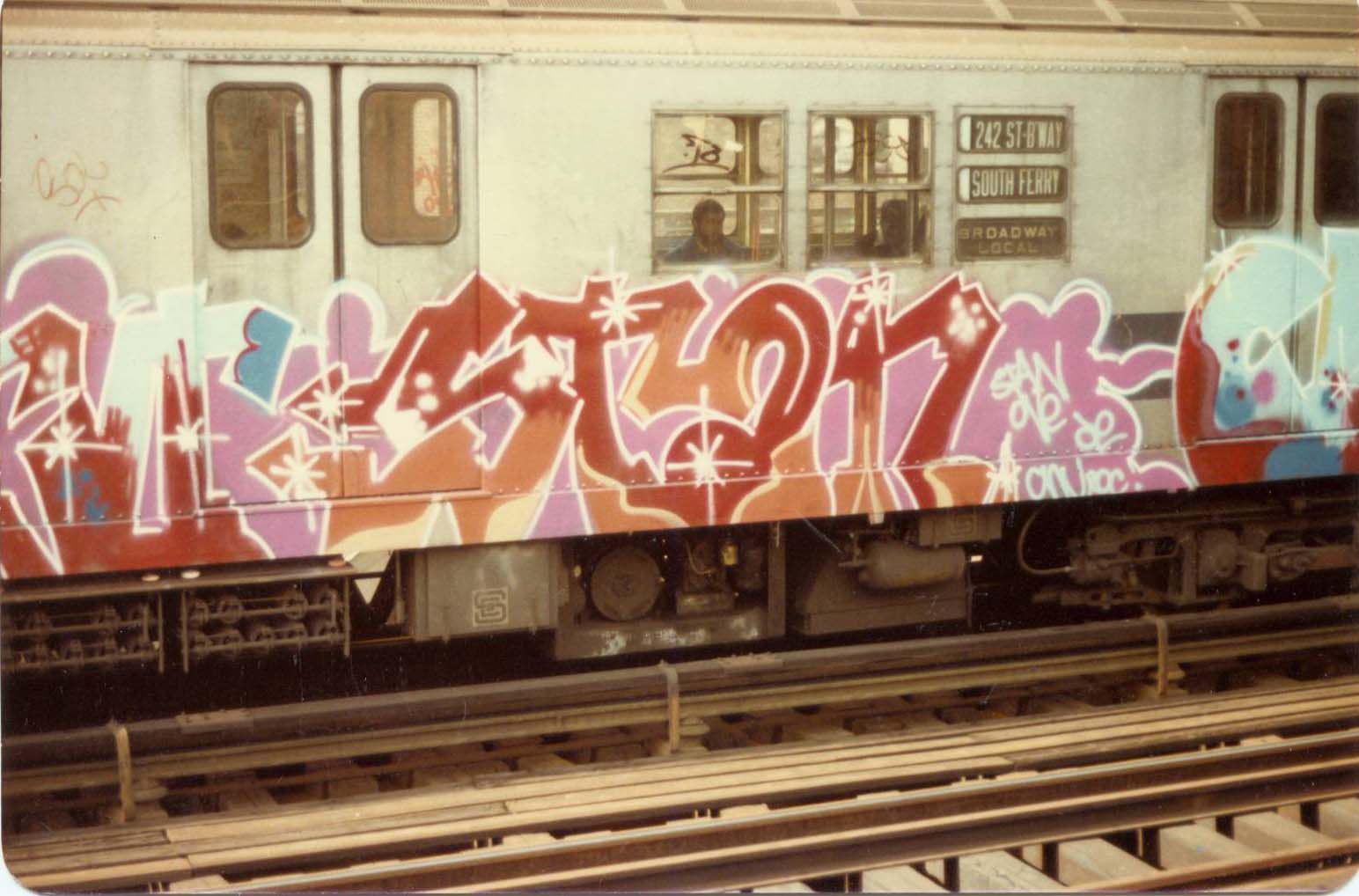


The writers' bench was more than a place to sit. Subway platforms became meeting points where writers could watch painted trains pass, see new pieces, meet other writers, trade information, compare styles, sketch and photograph work. Long before social media, the bench helped information and reputation move through the scene.
The famous bench at 149th Street–Grand Concourse became closely associated with New York graffiti culture. The larger idea of “the bench” also describes the social network around watching trains and exchanging knowledge.
Period history, station photographs and first-person recollections document the 149th Street–Grand Concourse meeting point and the practice of watching painted 2 and 5 trains pass through.
The bench connects directly to the photographers and filmmakers who preserved temporary work. It also makes an important point about graffiti history: style did not develop in isolation. Writers saw names roll through, met people behind them, learned crew relationships and compared work in motion. When a train was cleaned or repainted, a photograph could become the surviving record.

This archive is structured to pair verified photographs with handstyles, throw-ups, straights, pieces, blackbook pages, street repetition and regional scenes. Each image entry should carry writer when known, city, approximate date, photographer/source and uncertainty where identification is incomplete.
Style history becomes clearer when the same basic questions are asked at every scale: What happened to the skeleton of the letter? How did width, proportion, spacing, outline, connections, extensions, shadow and color change? Early signature culture developed into increasingly elaborate forms, but those forms overlapped rather than replacing one another.
Ignore color for a moment. Compare the main strokes, negative space and proportions. Then add outline, overlap, connections and extensions back in. This makes stylistic change visible without pretending every writer followed the same progression.
Henry Chalfant's archive preserves more than 1,500 photographs and hundreds of ephemeral subway works, including writers such as Blade, Daze, Lady Pink, Lee Quiñones, SEEN, Skeme and T-Kid. Those records make side-by-side study possible long after the trains were cleaned.


This layer prioritizes identified period photography over filler. The Smithsonian's Henry Chalfant series contains 24 New York City subway-graffiti photographs dated 1977–1980, including cataloged works by FUSE, SEK/GREG, LEE/SLAVE, MARK 198, ZEPHYR, BLADE, REVOLT, VANDAL, CRUNCH, PUSH/ART and others.
PHOTO RULE: Do not pad the page with repeats. A new image earns space when it adds a different writer, era, letter structure, surface, city, blackbook/material example or documentary viewpoint. Copyright/use restrictions remain attached to the source record; linking a catalog record does not claim reuse rights.
Use the dated photographs to compare letter width, connections, fills, outlines, scale and composition across period work. The point is not to rank writers; it is to train the eye using identified historical material.
OPEN THE 24-PHOTO SMITHSONIAN SERIES →Subway history is part of graffiti history. Riding on top, between, on the side or on the rear of a moving train is not. There is no safe version of subway surfing: one slip, low beam, signal structure, sudden movement or loss of balance can cause catastrophic injury or death.

New York City officials reported 16 confirmed subway-surfing deaths since tracking began in 2022, along with severe injuries including traumatic brain injuries and limb loss. Children have been among the victims.
A successful-looking video shows the few seconds that went right. It does not show the fall, permanent disability, death, family grief or emergency response when something goes wrong.
No photo, clip, like, dare or reputation is worth a life. If you see someone riding outside a moving subway train, alert transit staff or emergency services rather than following them or trying the stunt yourself.
Rappel graffiti has become one of the most visible developments in contemporary writing. Instead of treating the lower wall as the limit, writers have produced enormous vertical names across high-rise facades and other elevated surfaces. Photography and social media then carry an otherwise local piece around the world almost immediately.
Graffiti has long attached status to visibility and difficult placement. A multi-story vertical name can visually dominate smaller work around it and make the architecture itself part of the composition. Within parts of the culture, that combination of commitment, scale and seemingly impossible placement can carry enormous reputation.
RAMS MSK, originally from Aotearoa/New Zealand, has become one of the prominent names associated with contemporary high-rise and rappel graffiti. Recent documentation also follows writers including NOTICE, ENDEM, EXR, SKEAM, DSABL, SKIE, REWTS and ZONER as the approach appears across different cities and countries.
A giant vertical piece creates an immediate question — how did that name get there? That visual shock, combined with competition for new placements and global sharing of photographs and video, has helped turn what was once a fringe approach into a recognizable contemporary graffiti movement.
Working at extreme height can have catastrophic consequences. The archive records accidents and deaths alongside the art and reputation surrounding these pieces, but does not provide access, rigging, anchor or descent instructions.
Miami and Los Angeles produced two defining recent examples of writers collectively transforming stalled or abandoned high-rises. At that scale, the individual name still matters, but the building itself becomes the image: hundreds of marks competing, overlapping and combining into one temporary landmark.
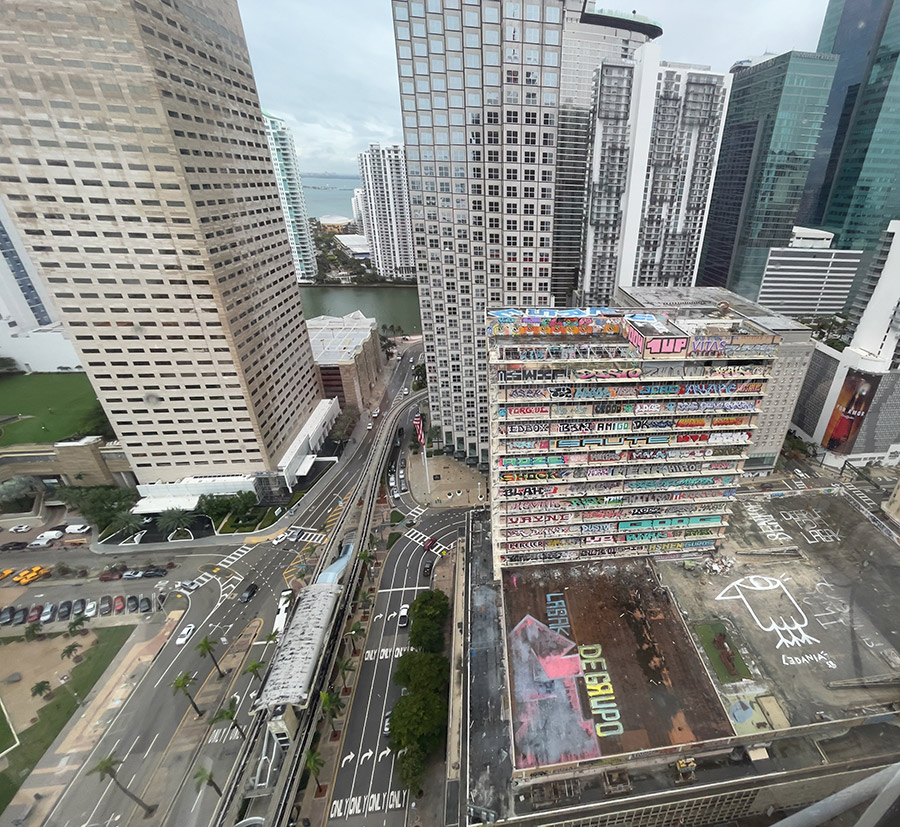
During Art Basel week, local and international writers covered the vacant downtown structure across multiple floors and facades. Documentation shows names including 1UP among a dense field of writers. The building became a city-scale graffiti image before its planned redevelopment.

The unfinished three-tower development opposite Crypto.com Arena became covered across dozens of floors. Its visibility pushed the event far beyond the local scene and into international news, turning a failed luxury development into one of the decade's most recognizable graffiti landmarks.
These takeovers echo an older graffiti principle: repetition by many writers can transform infrastructure itself. Subway cars once carried that accumulated visual culture through New York; a covered high-rise can turn an entire skyline surface into the record.
The archive does not stop at New York. Photography, touring writers, film, music, books, magazines, travel, VHS/DVD trading and eventually the internet helped imagery and ideas circulate internationally. Every region also developed its own history, surfaces, vocabulary and visual language.
The American archive already points outward: Philadelphia's early name-writing history, Los Angeles and West Coast traditions, Chicago and other regional scenes, freight networks and later international movements each need their own chronology, vocabulary and first-person sources. The regional index will grow city by city rather than treating difference as a footnote.
Future regional entries will identify the city, era, writers and photographers when verifiable rather than presenting graffiti as one universal style exported unchanged from New York.


PHILADELPHIA — early name-writing history and local handstyle lineage deserve their own chronology.
LOS ANGELES — walls, streets, local lettering traditions and crew histories need to be read through Los Angeles sources.
CHICAGO — document local crews, surfaces and terminology without forcing an NYC timeline onto the city.
SÃO PAULO — distinguish local writing traditions, including pixação, from New York-derived categories.
EUROPE — trains, walls, magazines and video networks helped scenes circulate, but each city developed its own history.
Spectacular productions are only one part of the record. Tags, repeated names, shutters, trucks, rooftops and ordinary street repetition belong here too.
Graffiti exists inside a larger world of lettering. New York neighborhoods were full of hand-painted storefronts, bodegas, windows, trucks, price signs and commercial signs alongside transit typography, comics, posters and album graphics. Direct influence should be claimed only when documented; visual parallels can still teach readers how letters occupy public space.
This is an original instructional diagram, not an imitation of a writer's hand. Use it to train the eye before comparing documented historical work.
Use the same questions when studying a bodega sign, a handstyle, a straight letter or a complex piece. The visual languages are different, but proportion, spacing, weight and negative space remain useful ways to look.
Hand-painted storefronts, wall signs, windows and commercial lettering show how type, color and spacing lived in public space long before today's digital sign systems.
Compare width, weight, outline, shadow, spacing, rhythm and readability across commercial signs and graffiti lettering. The point is not to claim one copied the other — it is to learn to see letter construction everywhere.
Storefronts, bodegas, windows, trucks and hand-painted advertising turn functional words into neighborhood visual identity.
Weight, width, spacing, rhythm and hierarchy show why two versions of the same word can feel completely different.
Stroke, movement, pressure and repetition offer another way to understand why a handstyle can be simple yet highly individual.
Characters, outlines, exaggeration, motion and visual storytelling sit naturally beside letter-based work.
Public graphics and music packaging show lettering designed to demand attention quickly.
Stations, trains, steel, brick, concrete and signage shape how lettering is seen at neighborhood and city scale.


Color, arrows, characters and effects come after structure. Complexity by itself does not make stronger lettering.
A piece can contain many effects and still have weak letters. Read the underlying construction first; decoration should support the word rather than hide it.
More arrows, colors and effects do not automatically make stronger letters.

The archive treats pioneers as connected people, not isolated trading cards. Each path connects first-person accounts, photographs, contemporaries, crews, publications and films so readers can follow how styles and reputations moved through the culture.
The Bronx Aerosol Arts Documentary Project records pioneers describing neighborhoods, crews, partners, influences and the everyday culture around writing. ROCKY 184 recalls Writer's Corner 188 and writers around him; STAFF 161 documents the early Ebony Dukes; BOM5 discusses forming crews including 5 Death Writers and Mad Writers. These accounts sit beside photographs and published histories rather than being reduced to one official origin story.
A central figure in Philadelphia's early name-writing history. His story belongs beside the broader Philadelphia scene and competing accounts of where modern graffiti writing begins.
His repeated name and street number became widely known after a 1971 New York Times story, making him a major reference point in accounts of early New York writing.
First-person history connects his subway work to the larger 1970s–80s scene, later studio practice and oral-history projects including Training Days.
Her story connects subway painting, crews and contemporaries, Wild Style, photography and a long career beyond the trains.
His appearance in Style Wars is one surviving document, not his entire biography. The archive connects film material to interviews and the wider scene.
The people who preserved the work have their own archive path connecting subway photographs, writers, Subway Art, Spraycan Art and Style Wars.
Use oral histories beside photographs and later scholarship. Memory can disagree, so the archive preserves attribution instead of flattening different accounts into one story.
A crew is more than letters after a name. Crews can create friendship, identity, mentorship, competition and a network through which styles and reputations travel. Membership and meaning change over time, so this archive ties crew claims to first-person histories wherever possible instead of presenting a frozen master list.
The Bronx Aerosol Arts Documentary Project identifies STAFF 161 as founder of the Ebony Dukes Graffiti Club. His oral history discusses the crew's early days and the gradual development of style during the signature era.
SEN-1's oral history identifies him as an original member of IBM. His account helps connect bombing, neighborhood experience and crew identity to the larger Bronx story.
DOSE's oral history traces his first encounters with graffiti, taking the name DOSE, joining Morris Park Crew and the social world around MPC — a reminder that crew history is also neighborhood history.
As the archive grows, those relationships should become clickable paths. A reader should be able to start with one writer and discover the people, crews, places, photographs, books and films around that writer without losing the original context.

Blackbooks and sketchbooks preserve ideas that may never have reached a train or wall: outlines, experiments, signatures from other writers, exchanged pages and visual memories of a scene. Their meaning was social as well as artistic.
In his Bronx oral history, REE describes seeing books passed from writer to writer at the bench and sometimes never finding their way back. T-KID 170 describes preserving old sketches, drawings, portfolios and blackbooks as valuable records of his history.
A page can preserve who signed it, whose style was being explored, when writers met and what ideas were being developed away from public surfaces. The archive treats books as historical objects rather than merely collections of finished drawings.


Graffiti is often temporary. Trains were cleaned, walls were painted over and buildings changed. Photographers, filmmakers, writers, publishers and collectors preserved moments that otherwise could have disappeared. Henry Chalfant's subway archive alone records hundreds of works that no longer exist on their original trains, making documentation part of the historical chain rather than decoration around it.
Her New York photographs documented writers, painted subway cars and the people and neighborhoods around the culture. Her work with Henry Chalfant in Subway Art became one of the most influential visual records of subway writing.
Chalfant systematically photographed subway cars and helped preserve pieces that existed only briefly. His archive connects directly to Subway Art, Spraycan Art and Style Wars.
The writer made the work; the photographer or filmmaker preserved that moment. Where known, both credits belong with the record.
The piece may disappear. The photograph, film, book or story can carry it forward.


Henry Chalfant's Smithsonian series contains 24 photographic prints from 1977–1980. Its catalog identifies subway works including FUSE, LEE, SLAVE, REVOLT, BLADE, ZEPHYR, CRASH, SEEN, SHY, KEL, MARK 198, PUSH and others. Use these cataloged names as anchors for studying period lettering rather than guessing identities from unlabeled photographs.
Books did more than preserve finished pieces. They moved photographs, vocabulary, interviews and letterforms between cities and generations. Entries here separate original publication history from later editions and connect each title to writers, photographers, films and scenes elsewhere in the archive.
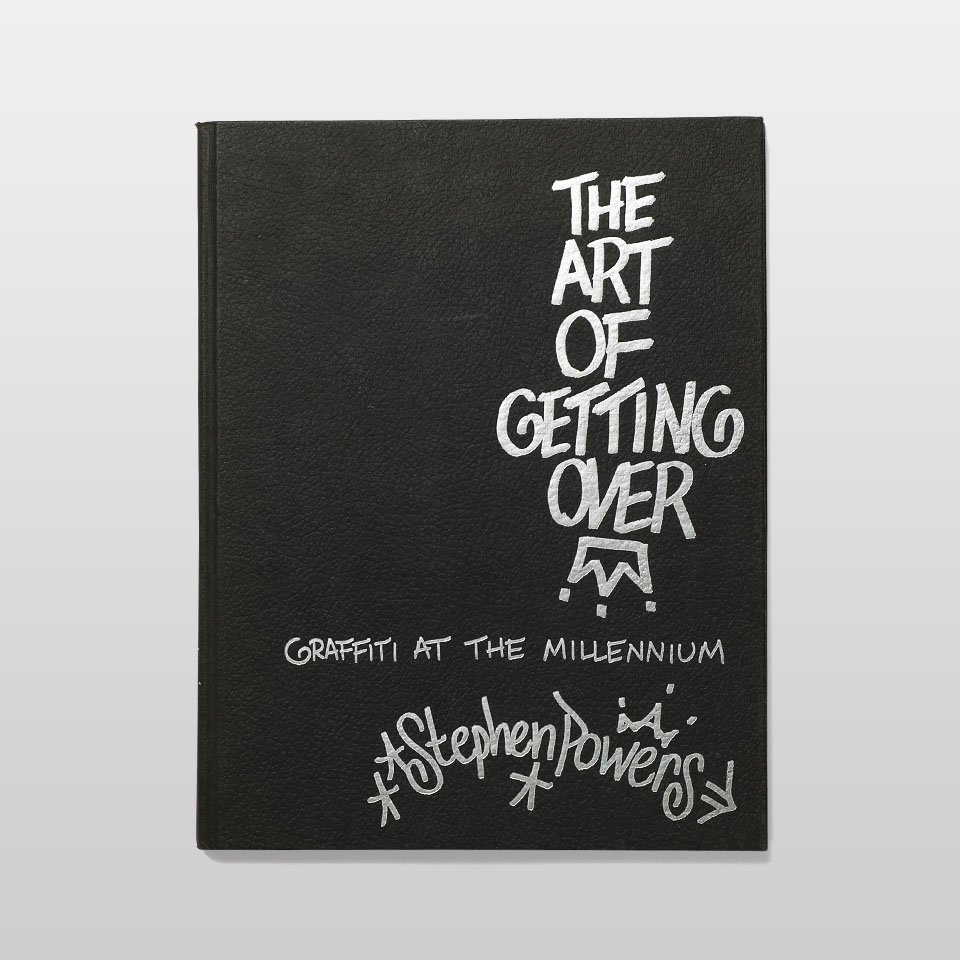
Stephen Powers' insider history combines photographs and interviews with early and later writers. The first edition was published by St. Martin's Press in 1999.

Martha Cooper and Henry Chalfant's photographic record of New York subway writing became one of the major visual documents through which the culture traveled internationally.
Henry Chalfant and James Prigoff expanded the view beyond New York, documenting walls and writers across cities in the United States and Europe.
Built from interviews, Castleman's study documents the people, vocabulary and social organization surrounding New York subway graffiti from inside the scene.
Sacha Jenkins interviews twelve writers including Daze, Lady Pink, Sharp and Skeme, creating first-person accounts of New York's late-1970s and 1980s writing culture.
A key early publication pairing writing about the phenomenon with photographs of New York graffiti. It belongs beside contemporary journalism rather than being treated as a retrospective source.
Connects railroad moniker history with modern freight writing and gives the archive a path beyond subway-centered histories.
A broad American survey useful for connecting New York and Philadelphia to regional scenes across the United States.
Film did something still photography could not: it preserved voices, movement, trains in motion, arguments about graffiti and the atmosphere surrounding the work. Mainstream documentaries and underground writer-made videos belong in the same history, but their production and distribution were very different.
Tony Silver and Henry Chalfant's documentary records New York subway writing and breaking alongside family, transit-authority and city perspectives. It remains one of the central moving-image documents of the era.
A fictional narrative built with people and elements from the early hip-hop scene, making it a different kind of historical object from a documentary like Style Wars.
A New York-focused release organized around the boroughs and writer interviews. Period scene discussion helps document its mid-2000s circulation.
A multi-volume underground title remembered through physical media, collector lists and scene discussion. Metadata stays labeled until original editions are verified.
The French series became an important document of European train writing and later international movement between scenes.
Video magazines, crew tapes and traded VHS/DVD releases created a pre-feed network where writers could see scenes far outside their own city.
Use film as a visual and oral-history layer alongside books, photographs and archive records. Links open the source video on YouTube.
ARCHIVE RULE: Video is supporting evidence. Writer statements, dates, crew claims and historical “firsts” are cross-checked against primary photographs, oral histories, books and institutional archives before being presented as settled fact.
Before feeds and streaming, graffiti video moved through VHS, DVD, shops, mail order, trades and copied tapes. This archive treats those releases as cultural documents: city, year, format, writers or crews when verified, original artwork where display rights allow, contemporary discussion, and a legitimate watch/find source when one survives.
Old forum posts are useful evidence that a title circulated, but they are not automatically authoritative metadata. Release details are cross-checked against publishers, filmmakers, surviving physical media, shops, catalogs and contemporary scene sources.
A New York-focused release organized around the five boroughs, combining writer interviews with street footage. Contemporary 12ozProphet discussion documents its 2005 shop release and names writers appearing across borough segments.
A multi-volume underground title repeatedly traded and discussed in graffiti-video forums. Each volume will remain marked for metadata verification until an original release, physical copy or reliable catalog source confirms its details.
The influential French train-writing series culminated in Search & Destroy. The 2006 third film follows train-writing across European cities and into New York; surviving retailer and documentary-catalog records preserve release information.
Swedish train and metro graffiti footage associated with Stockholm and WUFC. Contemporary graffiti forums show the series circulating internationally on downloaded and physical video.
A European train-writing video series visible in early-2000s scene discussion and trading lists. Individual volumes will be cataloged separately as original metadata is verified.
Documented in period graffiti-video lists and forum circulation. Kept in the research queue until release year, geography and original publisher can be verified.
Another title preserved in old graffiti-film lists. It belongs in the discovery index now, with full descriptive metadata added only after stronger source confirmation.
Appears in period graffiti-video indexes. The archive will distinguish verified facts from community memory rather than filling gaps with guesses.
Part of the wider underground-video trail preserved through scene forums and collector references. Volumes and release data will be separated once primary or near-primary sources are found.
Videograf, crew tapes, regional compilations, European train films and independent DVD/VHS releases will become a searchable index rather than a short recommendation list.
Before social feeds, magazines and photocopied zines were part of the network. They carried flicks, outlines, interviews, scene reports, mail-order information and addresses across cities and countries. The archive will catalog publications by place, years active when verifiable, format and what they actually documented.
A New York magazine covering hip-hop broadly, with graffiti represented through recurring writer-focused material and a mail-order network that also circulated books, magazines and videos.
Stephen Powers' publishing work belongs in the archive alongside The Art of Getting Over, showing the direct link between writers, independent publishing and scene documentation.
Its Blackbook Format focused individual issues on a writer or crew with large-format photographs intended to make style easier to study.
Art Crimes' surviving magazine index preserves names of a huge range of publications, including Stylefile, Under Pressure, Underground Productions, While You Were Sleeping, Xylene and many others for deeper verification.
Graffiti has its own vocabulary, but terms can shift by city, generation and scene. This glossary uses broad definitions as a starting point and leaves room for regional differences.
Graffiti history is not only the history of large finished pieces. Repeated names, handstyles, throw-ups and the circulation of a writer's identity through a city are central to understanding the culture. Scale, complexity and polish are only part of the record.
If a term means something different in Philadelphia, New York, Los Angeles, London, São Paulo or another scene, the regional usage belongs beside the general definition.
Graffiti history cannot be told only through polished pieces. Handstyles, throw-ups and repeated names are central to how writers became visible and how local scenes developed. The surfaces changed with the city: shutters, trucks, walls, rooftops, elevated corridors and other highly visible urban surfaces all became part of the visual record.
By the late 1980s, New York's clean-train program was rapidly removing painted cars from service; the MTA marks May 12, 1989 as the point when the subway fleet was declared graffiti-free. Writing culture continued on other surfaces and in other cities. Streets, walls, shutters, rooftops, trucks, highway-facing spaces and legal walls became increasingly visible parts of the photographic record, while subway-era styles and relationships continued to influence later generations.
A spectacular whole car or giant facade is easy to archive because it demands attention. Repeated smaller writing can be just as important historically because it shows how a name circulated through a neighborhood or city.
Philadelphia, New York, Los Angeles and later international scenes developed different local habits, letterforms, surfaces and vocabulary. Regional entries should document those differences with photographs and first-person accounts rather than forcing every scene into one template.


“Anti-style” is a contested label for work that pushes against conventional expectations of polished construction, balance and refinement. Some writers associated with unconventional contemporary graffiti reject the term itself. That disagreement is part of the history.
Once accepted styles become familiar, rejecting those expectations can create a new visual language. Deliberate awkwardness, naïve-looking forms and distortion can be intentional decisions rather than technical accidents.
Critics argue that generations developed sophisticated letter structure, rhythm, movement, color and control. Germes Gang, interviewed by MTN World, criticized the “anti-style” label and argued that its popularity can let people bypass learning fundamentals. That is a critique from within contemporary graffiti, not simply an outsider complaint.
If you understand strong letter structure and deliberately break it, is that different from never learning the structure?
Readers should compare what happens to the same fundamentals — proportion, rhythm, negative space, connection and movement — instead of deciding from “clean” versus “ugly” alone.
The look of writing is tied to what was available: markers, spray paint, caps, paint sticks, rollers, inks, surfaces and the limitations of each tool. Materials also connect to status, improvisation and the forms writers could repeat at different scales. This section documents those objects historically and visually rather than treating one era's equipment as universal or turning the archive into an instruction manual.
Packaging, markers, caps, cans and blackbooks will be added when their source and display rights are clear. Until then, this area stays editorial rather than filling the archive with unattributed product photography.
Future entries can show period packaging, manufacturer changes, cap design, paint behavior, marker construction and how writers adapted available products to different surfaces.

Walls are painted, trains are cleaned, buildings are demolished and paper deteriorates. Graffiti history survives through photographs, contact sheets, blackbooks, magazines, flyers, books, video, interviews and personal collections. The archive should make the documenter visible too.
The original work exists in a specific place and moment.
A temporary work becomes a record that can outlive the surface.
The record circulates beyond its original city and audience.
Images and oral histories can be indexed, compared and connected — while credit and rights still matter.
Where known, both belong with the image. The person who made the work and the person who preserved the moment are different credits.
A photo without context can become misinformation. Dates, locations and identifications should be verified when possible and uncertainty should stay visible.
Photographs, blackbooks, books, magazines and films work together here. Regional documentaries are used to preserve voices and visual context; dates, affiliations and disputed firsts stay tied to the strongest available source.
Historical image records should carry, when verifiable: writer or crew • city • approximate year • photographer/documenter • original archive/source. Unknown information stays marked unknown rather than guessed. Disputed identifications remain labeled as disputed.
The archive now points readers directly to institutional oral histories and photographic collections so early graffiti history can be followed through writer testimony and period documentation.
HOW TO USE IT: compare a writer's recollection with period photographs and archival metadata. When accounts conflict, keep the disagreement visible instead of inventing a single answer.
The finished Learn page will connect subjects instead of isolating them. A writer can lead to a city, a city to a film, a film to a photographer, a photographer to a book, and a book back to the styles and writers inside it.
Not a pile of articles. A connected visual history.
Use these as observation prompts, not a score. The goal is to notice relationships and know where to look next.
Look at scale, silhouette, stroke structure and repeatability. Then compare both in the Style Evolution chapter.
CHECK STYLE EVOLUTION →Follow the relationship among percussion, dancers, the crowd and early DJ technique.
CHECK CULTURE CONNECTIONS →Separate the underlying letter skeleton and proportions from fills, effects and extensions.
CHECK PIECE ANATOMY →Memory, perspective, neighborhood and time all matter. The archive keeps attribution and uncertainty visible instead of forcing one perfect origin story.
CHECK ORAL HISTORY →Short visual lessons: letter structure, marker control, sketching, color, outlines, shadows, highlights, blackbook practice, photographing work and understanding materials.
Long-form step-by-step tutorials are intentionally the final phase. History, archive, books, film and pioneer material comes first.
Original interviews, contemporary photographs, books, museum/archive records and period reporting will be prioritized. Disputed stories will be labeled as disputed. Images will be published only when there is a legitimate right or permission to display them.
GLOBAL ACTIVITY


